First visit? Access, reporting, queue and parikrama details: To be verified
Today: To be verified • Peak:
To be verified
Jyotirlinga No. 4
Omkareshwar Jyotirlinga Temple
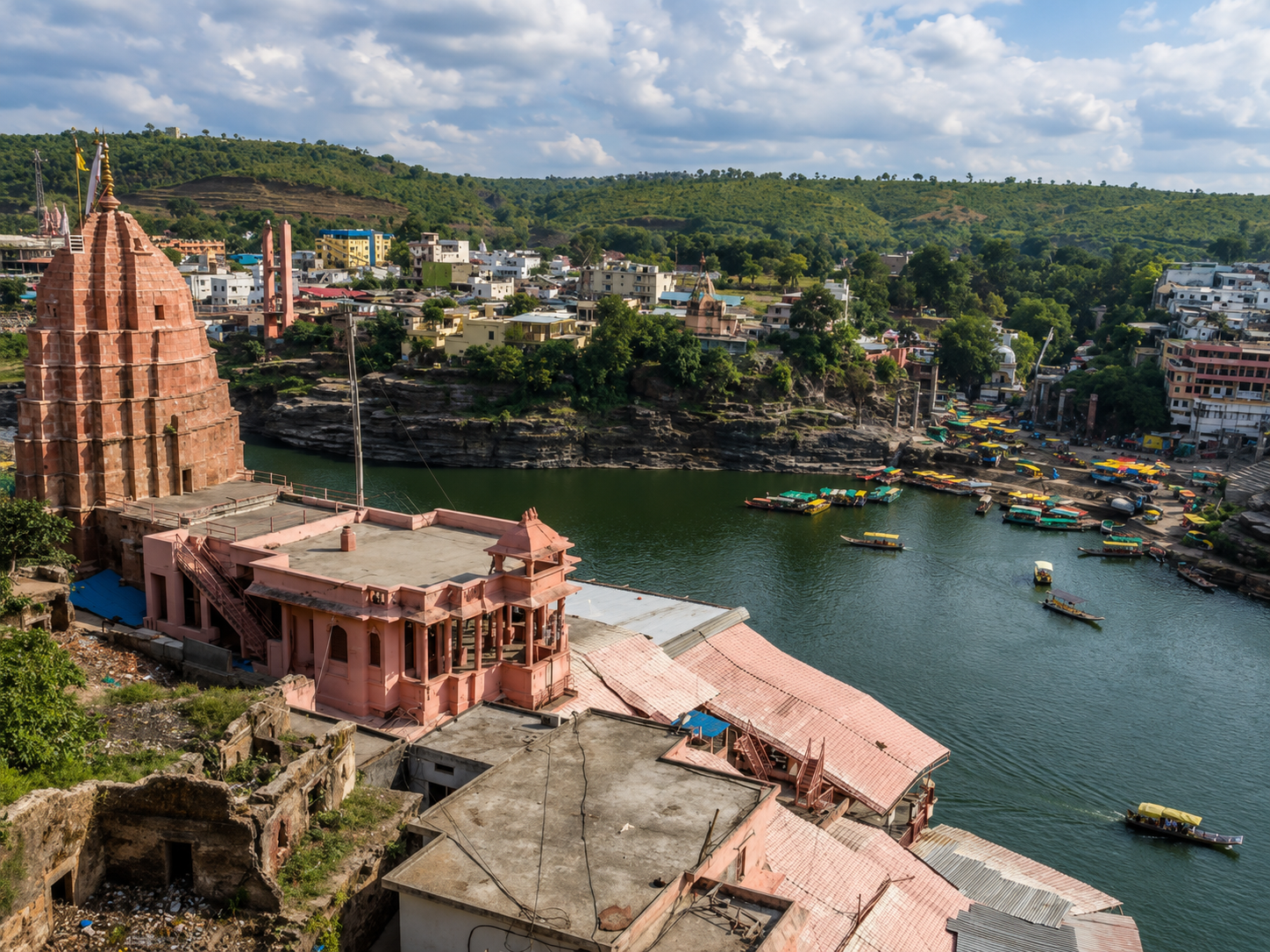
Sacred Mandhata Island in the Narmada River, Madhya Pradesh
Deity: Lord Shiva as Omkareshwar Jyotirlinga
Omkareshwar Jyotirlinga Temple is revered as Jyotirlinga No. 4,
the fourth among the 12 Jyotirlingas, and stands on sacred
Mandhata Island in the Narmada River in Madhya Pradesh.
The island is traditionally believed to resemble the sacred Om
symbol ॐ, and the shrine is known for Narmada devotion, river
ghats, Mandhata Island parikrama, paired worship with Mamleshwar,
and peaceful Shiva worship amid hills and flowing waters.
Timings, access rules, route conditions, crowd guidance, booking
details and parikrama details: To be verified.
Meaning of Omkareshwar
Lord of the Sacred Om Sound
Om means the sacred cosmic
sound, Ishwar means Lord, and Omkareshwar means Lord of the
Sacred Om Sound.
Om = Sacred SoundIshwar = LordLord of Omkara
Temple Status
To be verified
Temple opening status:
To be verified
Crowd Expectation
To be verified
Crowd guidance: To be
verified
Queue flow, route access and parikrama movement: To be
verified
Next Aarti
To be verified
Aarti details: To be
verified
Best Darshan Window
To be verified
Preferred darshan window:
To be verified
Recommended
Route flow, darshan timing, access pattern and parikrama
details: To be verified.
Today: To be verified.
Map
Map
Temple Location Snapshot
Sacred Mandhata Island in the Narmada River, Madhya Pradesh
Understanding the spiritual importance of Omkareshwar
Jyotirlinga
No. 4 and fourth among the 12 Jyotirlingas of Lord
Shiva
Located on sacred Mandhata
Island in the Narmada River
Associated with the sacred
Om-shaped island belief and symbolism of ॐ
One
of the auspicious east-facing Shiva shrines of Madhya
Pradesh
Connected
with Mamleshwar Temple and the wider
Narmada pilgrimage circuit
Omkareshwar Jyotirlinga Temple is located on sacred Mandhata
Island in the Narmada River and is regarded as the fourth among
the 12 Jyotirlingas. The island’s Om-shaped sacred geography
gives the shrine its name and special spiritual symbolism, while
the temple is surrounded by hills, flowing river waters, ghats,
and ancient spiritual sites.
Omkareshwar Jyotirlinga Temple mainly faces east. In Hindu
tradition, east-facing temples are considered auspicious because
they welcome the rising sun and symbolize positivity, purity, and
divine energy.
Omkareshwar brings together Shiva
worship, Narmada devotion, Mandhata Island parikrama, and the
peaceful rhythm of river-island pilgrimage.
Ancient legends connect Omkareshwar with the
prayers of the Devas, Lord Shiva’s protective grace, and the
manifestation of a divine Jyotirlinga on sacred Mandhata Island.
According to ancient legends, the
Devas prayed to Lord Shiva for protection from powerful demons, and Shiva
appeared on Mandhata Island in two sacred forms: Omkareshwar and
Amareshwar / Mamleshwar.
Sacred legend
According to ancient legends, the Devas once prayed to Lord
Shiva for protection from powerful demons. Pleased with
their devotion, Shiva appeared as a divine Jyotirlinga on
Mandhata Island in the sacred Narmada River.
Lord Shiva is worshipped here in two sacred forms:
Omkareshwar and Amareshwar, also known as Mamleshwar. This
sacred manifestation gave the Mandhata Island and Narmada
River region its enduring importance as a major Shiva
pilgrimage center.
Two sacred forms
Omkareshwar and Amareshwar / Mamleshwar
Shiva is traditionally worshipped here in two linked forms
of the same sacred Jyotirlinga presence.
Pilgrimage identity
Mandhata Island and the Narmada region
The legend made this river-island setting one of the major
centers of Shiva pilgrimage and devotion.
Temple History
Omkareshwar has ancient roots and is
mentioned in Puranas and ancient pilgrimage records. Over centuries it
became an important center of Shaivism, pilgrimage, meditation, and
Narmada river worship.
The temple tradition is associated
with early medieval development, including an 11th century CE Paramara
connection, later Chauhan stewardship, and Maratha patronage that helped
sustain the shrine.
Sacred timeline
Omkareshwar Jyotirlinga Temple has ancient roots and is
mentioned in Puranas and ancient pilgrimage records. The
shrine grew into an important center of Shaivism,
pilgrimage, meditation, and Narmada river worship on
Mandhata Island.
The temple tradition is associated with contributions from
Hindu dynasties and rulers, especially the Paramara
dynasty, Chauhan rulers, and later Maratha patronage.
Omkareshwar Temple is traditionally associated with early
medieval development, including an 11th century CE
Paramara connection, while later restorations helped
sustain the shrine’s living pilgrimage tradition.
Ancient record
Puranas and pilgrimage records
Omkareshwar is rooted in longstanding textual and
pilgrimage traditions linked with the Narmada.
Early medieval link
Paramara and Chauhan tradition
The temple tradition is associated with Paramara and
Chauhan support in the early and later medieval periods.
Later patronage
Maratha support and continuity
Maratha patronage helped revive and sustain the
pilgrimage-centered life of the shrine.
Temple Architecture & Design
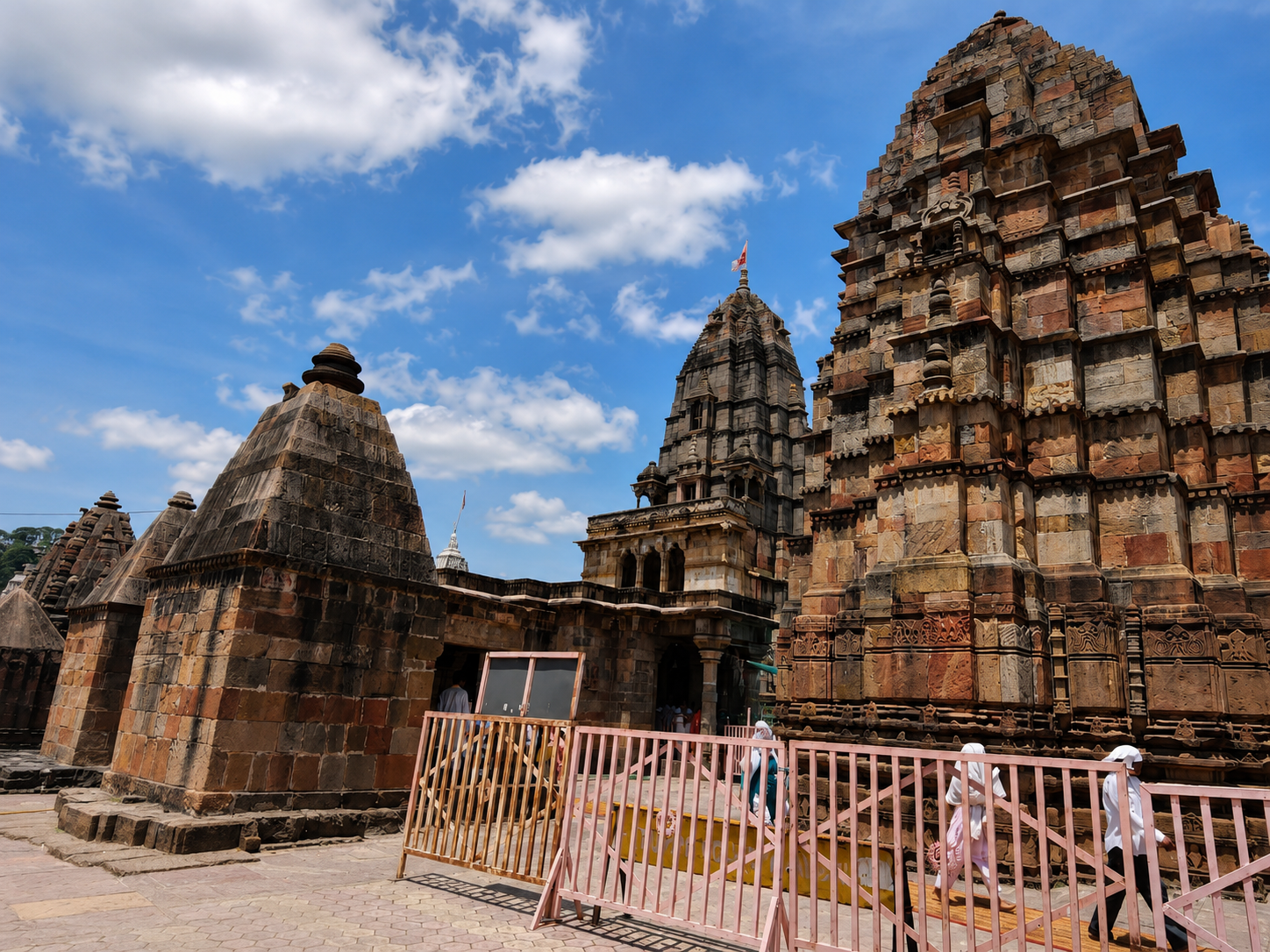
Omkareshwar reflects Nagara-style temple
architecture through a multi-level sacred complex, carved shrine spaces,
river ghats, and the rare setting of a Jyotirlinga on an island in the
Narmada River.
The temple is known for its
beautifully carved pillars and mandapas, sacred ghats, temple shikhara
overlooking the Narmada River, and stone pathways and parikrama routes
around Mandhata Island.
Sacred design
Omkareshwar follows a Nagara-style sacred layout with a
multi-level temple structure, beautifully carved pillars,
mandapas, and the main shikhara rising above the
Narmada-facing pilgrimage setting. The temple experience
also includes sacred river ghats and shrine spaces shaped
by living worship rather than only formal monument
language.
The island setting supports stone pathways, parikrama
routes, bridges, and ritual movement across Mandhata
Island. Together these elements make Omkareshwar a rare
river-island temple setting among the Jyotirlingas, while
preserving the long continuity of Narmada pilgrimage.
Architecture style
Nagara-style temple architecture
The shrine combines classical temple form with a living
island-pilgrimage setting.
Sacred layout
Shikhara, mandapas and river ghats
The temple’s carved spaces and ghats shape the
devotional approach to the Narmada.
Pilgrimage routes
Stone pathways and island parikrama
Mandhata Island’s pathways and circumambulation routes
define the rare river-island pilgrimage experience.
Spiritual Importance & Sacred
Features
Omkareshwar is revered for the sacred power
of Om, the peace of Narmada worship, the paired devotion of Omkareshwar
and Mamleshwar, and its place as a center of meditation and Shiva
bhakti.
Worship at Omkareshwar is believed to
bring peace, wisdom, spiritual growth, and liberation, while the sacred
sound Om is revered as the origin of divine consciousness.
Sacred devotion
Worship at Omkareshwar is believed to bring peace, wisdom,
spiritual growth, and liberation. The sacred sound Om
symbolizes the origin of the universe and divine
consciousness, which deepens the shrine’s devotional
importance for seekers of Shiva bhakti.
The temple is associated with meditation, river
purification, Narmada worship, and the steady discipline of
Shiva devotion. Omkareshwar Temple is situated on Mandhata
Island, while Mamleshwar, also called Amareshwar, is
located on the southern bank of the Narmada River.
Omkareshwar Temple and Mamleshwar Temple are spiritually
connected.
Together, the two temples are traditionally believed to
complete Omkareshwar Jyotirlinga worship, and devotees
often visit both as part of the same sacred circuit.
Omkareshwar is also linked with Adi Shankaracharya, who is
traditionally believed to have met his guru Govinda
Bhagavatpada in a cave near the shrine. This association
strengthens Omkareshwar’s importance as a spiritual
learning and meditation center. Omkareshwar is also an
important stop in the holy Narmada Parikrama pilgrimage,
where devotees walk around the sacred river region for
spiritual purification and blessings.
Om-shaped
Mandhata Island
Omkareshwar
and Mamleshwar paired worship
Narmada
Parikrama pilgrimage
Narmada
River and sacred ghats
Adi
Shankaracharya connection
Govinda
Bhagavatpada Cave connection
Spiritual
learning and meditation center
Major pilgrimage
Narmada Parikrama
Omkareshwar is an important stop in the holy Narmada
Parikrama pilgrimage.
Paired worship
Omkareshwar and Mamleshwar
Devotees often visit both temples together as part of the
same sacred circuit.
Spiritual lineage
Adi Shankaracharya and Govinda Bhagavatpada
The cave tradition near Omkareshwar links the shrine with
spiritual learning and meditation.
Darshan Process
A quick visual flow from entry point to
exit.
Average total time: To be
verified
Verify Before Visit
1
Reach Temple Area
Final drop point and
temple approach details: To be verified.
2
Clear Security
Phone, bag and
restricted-item rules: To be verified.
3
Join Queue Lane
Queue format, darshan
lane and access pattern: To be verified.
4
Move Final Stretch
Internal access path,
batch movement and reporting steps: To be verified.
5
Take Darshan
Darshan duration and
inner-entry flow: To be verified.
6
Follow Exit Flow
Exit route, re-entry
rules and nearby movement guidance: To be verified.
Check latest
timing, aarti access, crowd guidance, route access and parikrama
details before visit.
Verify Before Visit
Temple timing, aarti
schedule, access and parikrama details: To be verified.
Temple StatusTo be verifiedDaily schedule and
ritual access: To be verified.
Current
GuidanceTo be verified
Next AartiTo be verifiedTo be verifiedBest Darshan WindowTo be verifiedTo be verifiedCrowd ExpectationTo be verifiedTo be verifiedTemple
ClosesTo be verifiedTo be verified
Daily
Entry
Temple Timings
Temple OpensTo be verified
Best Darshan WindowTo be verified
General DarshanTo be verified
Most
sensitive ritual windowTo be verified
Temple
ClosesTo be verified
Main
Rituals
Aarti Schedule
Morning
AartiNextTo be verified
Abhishekam / ArchanaNextTo be verified
General Aarti WindowNextTo be verified
Evening
AartiNextTo be verified
Temple ClosesNextTo be verified
Temple timing, aarti
schedule, access and parikrama details: To be verified.
For most devotees, Omkareshwar planning
is about both season and route timing. Daily darshan timing, crowd
pattern, access and pilgrimage details are To be verified.
Most balanced season
October to March
Cooler temperatures make it easier to handle island access,
local transfers and longer devotional days around the
Narmada.
Spiritually intense period
Narmada Parikrama and Shravan pilgrimage
Omkareshwar is an important stop in the holy Narmada
Parikrama pilgrimage, while exact peak movement and
festival-period handling remain To be verified.
Best daily window
To be verified
Preferred daily darshan and parikrama window: To be
verified.
Nearby Temples & Spiritual Circuit
Important pilgrimage stops to visit around
Omkareshwar Jyotirlinga Temple and the wider Mandhata Island and
Narmada spiritual circuit
Mamleshwar Temple
To be verified
Traditionally
paired with Omkareshwar Jyotirlinga and located on the
southern bank of the Narmada River.
Traditional offerings at Omkareshwar
are simple, devotional and closely tied to Shiva worship, with puja
essentials and sacred rituals usually arranged through trusted local
vendors or approved temple channels. For prasad availability, check
the temple counter on arrival.
Bel patra, flowers, milk or
abhishek items and Rudrabhishek remain the most familiar offerings for
devotees visiting Omkareshwar, while packaged prasad should be checked
at the temple counter.
Flowers
Fresh flowers and simple puja thali items are among
the most common devotional offerings for Lord Shiva
and are easily available through trusted local
vendors near the temple approach.
Bel Patra
Bel patra remains one of the most symbolically
important
offerings in Shiva worship and is often part of
simple,
focused puja at Omkareshwar.
Milk / Abhishek Items
Milk-based abhishek offerings are widely associated
with Shiva worship. Devotees should follow current
temple rules and approved puja procedures before
bringing ritual items inside.
Rudrabhishek / Abhishek
Rudrabhishek is one of the most sought-after temple
rituals for devotees seeking a deeper spiritual
offering experience at Omkareshwar. Use official
temple channel guidance for booking and reporting.
Offering Preview
Active offering
Flowers
Active offering
Bel Patra
Active offering
Milk / Abhishek Items
Active offering
Rudrabhishek / Abhishek
Before You Visit (Important Tips)
Short reminders that help avoid confusion
and keep darshan smoother.
Avoid These Mistakes
Do not
assume current aarti or darshan timing without
verifying the latest temple guidance.
Do not
mobile phone and large-bag rules: To be
verified.
Do not
aarti timing, crowd level and reporting cut-off: To be
verified.
Helpful Tips for Smooth Darshan
Reach
bridge approach, crowd pattern and calmer darshan
window: To be verified.
Keep
booking confirmation, ID and entry-check
requirements: To be verified.
Verify
current aarti booking and entry rules: To be
verified.
Before You Visit
A little planning before you leave for the
temple usually makes the
darshan experience calmer, especially on busier aarti days.
Arrival checklist
Prepare these basics before entering the temple zone
Security
checks, deposit needs and restricted-item handling:
To be verified.
Latest
darshan, aarti and puja timing: To be
verified.
River- or
island-side access, bridge use and local movement:
To be verified.
Festival-day
crowd pattern and arrival buffer: To be
verified.
Queue
movement, checkpoint timing and the final walking
approach: To be verified.
Mobile
phone, bag and electronics rules: To be
verified.
Booking
confirmation, ID requirement and ritual-slot
verification process: To be verified.
Planning note
Plan for the full arrival flow, not just temple
timings
Bridge access, local transfer, security checks and queue
pauses: To be verified.
Dress Code & Allowed Items
Simple, respectful choices usually make the
visit smoother than trying
to manage extra items near a tightly monitored temple entry.
Modest clothing, light items and
simple offerings usually make entry, walking and security checks much
easier.
Clothing
Dress modestly and comfortably
Temple-appropriate clothing is the easiest choice for
darshan
lines, walking access and longer devotional visits.
Modest clothing
is
generally the safest option.
Choose easy,
comfortable clothing for walking and
waiting.
Restricted items
Check the current rules before you carry extras
Bag, phone, electronics and deposit rules can vary by
crowd
control setup, temple guidance and security
enforcement.
Confirm the
latest rules for bags, phones, electronics and
leather items.
Security and
deposit procedures may change with the
situation.
Offerings
Keep puja items simple and temple-appropriate
Simple offerings are easier to manage and more likely to
fit
current entry expectations near the temple complex.
Keep offerings
modest,
clean and appropriate for Shiva
worship.
Confirm
local
guidance if you plan to carry special ritual
items.
Accommodation Near Temple
Where you stay affects how easy an early
darshan day feels, especially
when island access, bridge movement and local transfers become part of the
plan.
Staying near the temple precinct or
a practical transfer point usually makes early darshan planning much
smoother than depending on long city transfers.
Best area to stay
Choose a base that supports your darshan timing
If temple access is the priority, stay in an area that
keeps
the morning approach manageable instead of adding a long
transfer before the queue.
Temple precinct or Mandhata island side
Useful for walkable temple and city access
Staying near the temple side or nearby Mandhata island
area can make it easier to combine darshan, local
movement and nearby temple visits in one day.
Near railway station
Practical for shorter trips and easier transfers
This area can work better for visitors arriving by train,
carrying luggage or prioritizing simpler onward travel
over
walkable town-center ambience.
Budget and comfort
Balance price, access and early-start convenience
Budget stays can work well if access is clear, while
comfort
stays are often worth considering when your visit
depends on
rest, early reporting or family travel.
Convenience note
Town-center stays can be atmospheric but slower for arrival
Staying too deep inside older town lanes may feel immersive,
but it can complicate luggage movement, auto drop-offs and very
early temple starts.
Official Info & Booking Help
Use official confirmation for ritual
planning whenever your visit depends
on a specific booking, reporting time or access rule.
Use official sources first whenever
your visit depends on a puja slot, reporting window or paid ritual
booking.
Where to confirm
Start with official sources
For puja access, timing changes and reporting
instructions,
official guidance should be your first reference point.
Temple sourceCheck official
temple
source
Booking accessConfirm from
official booking portal
Special pujasUse official
helpdesk
guidance for ritual-specific support
Before you depend on a
booking
Verify the process before you travel
Reporting windows, entry rules and ritual availability
can
shift, so final confirmation matters even after you plan
the
trip.
Ritual processConfirm the
latest
booking method from the official source
Reporting timeCheck the current
reporting window before reaching the
temple
Third-party cautionAvoid
relying
only on unverified third-party booking
claims
Trust reminder
Use verified guidance when the visit depends on a paid
ritual
If your darshan day depends on a specific aarti or puja slot,
re-check official instructions shortly before travel rather than
depending only on older summaries or unofficial listings.
Temple Location
Use this location snapshot for last-mile
planning around the temple precinct, the Mandhata island approach and your
arrival point in the city.
CityMandhata Island
StateMadhya Pradesh
LandmarkOmkareshwar Temple and Mandhata Island
Railway StationOmkareshwar Road station / Khandwa route
AirportDevi Ahilya Bai Holkar Airport, Indore
AccessTo be verified.
Live Darshan Preview
Internal live accessOpen Divine Temple Guide live darshan for the active viewing
route.
Live darshan access
Live Temple Darshan
This sidebar card keeps live darshan discoverable on the temple page
while routing viewing access through the Divine Temple Guide live section.
Use the internal
live-darshan page for the next step.
Daily darshan timing, opening or closing schedule and ritual
windows are To be verified.
October to March is usually the more comfortable season for
Omkareshwar visits, but the preferred daily darshan and
parikrama window are To be verified.
Devotees should wear modest, temple-appropriate clothing.
Comfortable footwear helps before the final deposit point,
and simple traditional or respectful attire is the safest
choice for darshan and aarti visits.
Entry rules, phone restrictions, bag checks, route access and
current security process are To be verified.
Aarti availability, access procedure and booking requirement
are To be verified.
Mobile phone and electronic-item rules are To be verified.
Locker or deposit facility availability is To be verified.
Average darshan duration is To be verified.
Online pooja booking availability and current booking rules are
To be verified.