Approach:Somnath station is about 0.5 km away; Veraval station is about 7 km away
First visit?Aarti is at 7:00 AM, 12:00 Noon and 7:00 PM; electronics go to free cloak-room lockers
Today: To be verified • Peak:
To be verified
Jyotirlinga No. 1
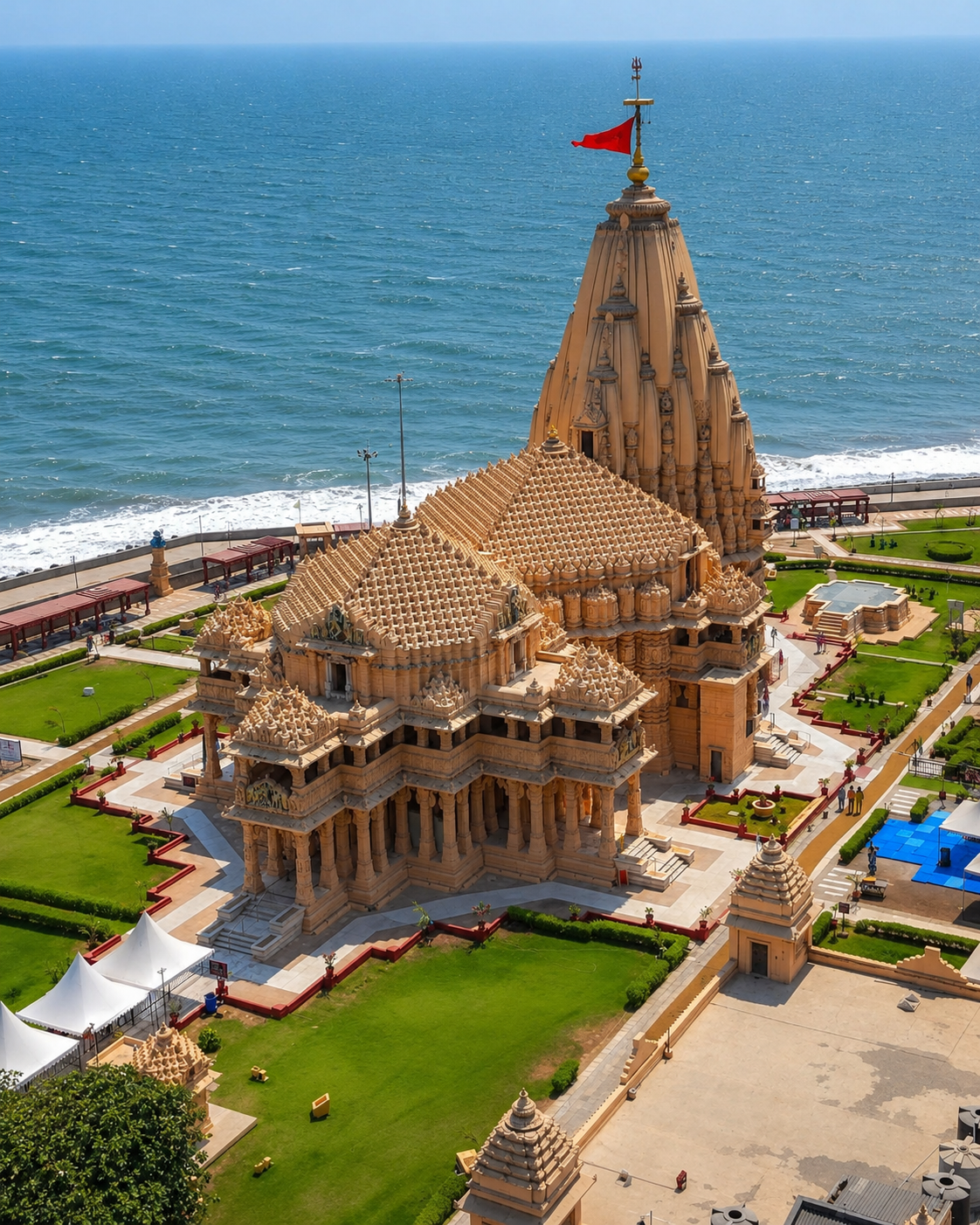
Somnath Jyotirlinga Temple
Prabhas Patan near
Veraval, Gujarat
Deity: Lord Shiva as Somnath Jyotirlinga
Somnath Jyotirlinga Temple is one of the most sacred temples of
Lord Shiva and is regarded as Jyotirlinga No. 1, the first among
the 12 Jyotirlingas, at Prabhas Patan near Veraval on the Arabian
Sea coast.
Somnath is known for its spiritual importance, sea-side setting,
long history of destruction and reconstruction, and the enduring
grace of Lord Shiva as Somnath, Lord of the Moon.
Verified fallback details are paired with live temple data where
available.
Meaning of Somnath
Lord of the Moon
Soma means Moon, Nath means
Lord, and Somnath means Lord of the Moon.
Soma = MoonNath = LordLord of the Moon
Temple Status
To be verified
Verify the latest temple schedule before travel.
Crowd Expectation
To be verified
To be verified
Verify locally before travel
Next Aarti
To be verified
To be verified
Best Darshan Window
To be verified
To be verified
Recommended
Plan around locally confirmed darshan and aarti timings.
Today: queue movement and ritual timings should be verified
locally.
Regarded
as Jyotirlinga No. 1 and first among the 12
Jyotirlingas
Located in Prabhas Patan near
Veraval on the Arabian Sea coast
An
east-facing temple, while the Arabian Sea lies on the
western side of the temple
Known
for spiritual importance and a long history of destruction
and reconstruction
Somnath is one of the most revered
Shiva pilgrimage sites on the Arabian Sea coast, and its
east-facing sanctity is traditionally considered auspicious because
it welcomes the rising sun and symbolizes positivity, purity, and
divine energy.
The sacred story of Somnath connects the Moon
God’s penance at Prabhas Kshetra with Lord Shiva’s grace as
Jyotirlinga No. 1.
Sacred legend
According to tradition, Chandra, the Moon God, was cursed by
Daksha Prajapati and lost his brightness. Chandra worshipped
Lord Shiva at Prabhas Kshetra to remove the curse. Shiva
blessed him, appeared as a Jyotirlinga, and Chandra then
established the Somnath shrine in devotion.
Daksha Prajapati’s 27 daughters are traditionally
associated with the 27 nakshatras. Chandra married all 27
daughters but favored Rohini and neglected the others, which
led to Daksha’s curse. Lord Shiva softened the curse so
the Moon would continue to wax and wane in cycles.
Moon God
Chandra
Worshipped Lord Shiva at Prabhas Kshetra for relief from the
curse.
Favored consort
Rohini
Chandra’s preference for Rohini led to Daksha
Prajapati’s curse.
Moon cycle
Waxing & Waning
Lord Shiva softened the curse so the Moon would wax and wane in
cycles.
Temple History
Somnath stands on one of the most
revered sacred sites in India.
The present shrine reflects the rebuilding of an ancient Jyotirlinga
tradition at Prabhas Patan after repeated destruction and renewal.
After India’s independence,
Sardar Vallabhbhai Patel initiated the rebuilding of the present Somnath
Temple. The current temple was inaugurated in 1951 by Dr. Rajendra
Prasad, reaffirming the sacred standing of the first among the 12
Jyotirlingas.
Sacred timeline
After India’s independence, Sardar Vallabhbhai Patel
initiated the rebuilding of the present Somnath Jyotirlinga
Temple. The current temple was inaugurated in 1951 by Dr.
Rajendra Prasad, restoring Somnath as a major center of
Shiva worship at Prabhas Patan.
The temple stands on an ancient Jyotirlinga site with a long
rebuilding history. Across those changes, Somnath has
remained one of the most important Shiva temples in India
and a central stop in the western pilgrimage circuit.
The continuing stewardship of the Shree Somnath Trust keeps
this sacred reconstruction legacy alive for present-day
devotees.
Present temple completed
1951
Current Somnath structure completed in the modern era.
Rebuilding initiative
Sardar Vallabhbhai Patel
Initiated the rebuilding of the present temple after
India’s independence.
Inaugurated by
Dr. Rajendra Prasad
Inaugurated the current temple in 1951.
Managed by
Shree Somnath Trust
Present shrine administration and rebuilding stewardship.
Temple Architecture & Design
The present temple complex reflects the
Maru-Gurjara sacred design tradition of Chalukya / Solanki
craftsmanship.
Its east-facing shrine, sea-side setting, and stone profile shape how
devotees recognize Somnath today.
Somnath follows the Maru-Gurjara
(Chaulukya / Solanki) tradition, Chalukya-style architecture, and
Kailash Mahameru Prasad expression, with a grand shikhara and classic
mandapa layout.
Sacred design
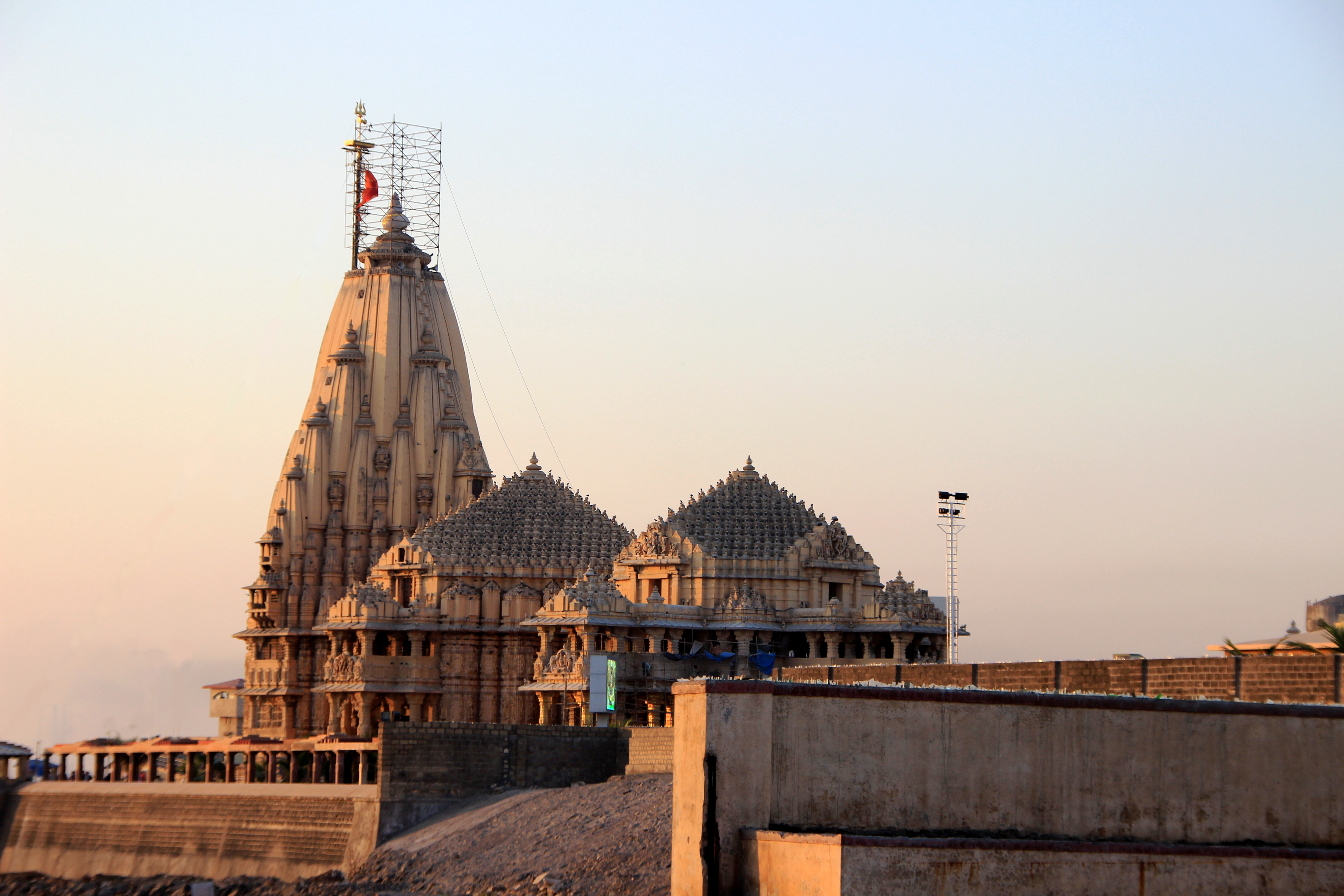
The temple is built in the Maru-Gurjara (Chaulukya /
Solanki) style and is also described in the Chalukya-style
Kailash Mahameru Prasad tradition. Magnificent stone
carvings, intricate pillars, the mandapa, garbhagriha, and
the traditional Hindu temple layout guide the devotional
movement of pilgrims through the shrine.
The present structure is associated with the rebuilding work
of the Shree Somnath Trust and the design vision of
Prabhashankar Oghadbhai Sompura. Somnath Jyotirlinga Temple
faces east, while the Arabian Sea lies on the western side
of the temple.
The grand main shikhara rises to approximately 155 feet, and
the sea-side temple structure is associated with the Baan
Stambh tradition, which indicates that no land lies
directly south of Somnath until Antarctica.
Architecture style
Maru-Gurjara / Chalukya
Chaulukya / Solanki tradition with Kailash Mahameru Prasad
association.
Sacred orientation
Faces East
The Arabian Sea lies on the western side of the temple.
Main shikhara
Approx. 155 feet
Grand vertical profile rising above the sacred
complex.
Baan Stambh tradition
Southern marker
Marks the belief that no land lies directly south until
Antarctica.
Sacred Features and Pilgrimage Highlights
Somnath stands out for its Jyotirlinga
primacy, Moon God connection, Arabian Sea setting, and rebirth through
repeated reconstruction.
Special features
Somnath is revered as the first Jyotirlinga and remains a major
Shiva pilgrimage site. Its sacred identity is deepened by the
Triveni Sangam near the Kapila, Hiran, and Saraswati rivers,
the temple’s repeated destruction and reconstruction as a
symbol of rebirth, its Arabian Sea view, and its strong
connection with Chandra, the Moon God.
Jyotirlinga No. 1 and
first among the 12 Jyotirlingas
Triveni Sangam near the
Kapila, Hiran, and Saraswati rivers
Symbol of rebirth because
the temple was destroyed and rebuilt multiple
times
Arabian Sea view and
sea-side sacred setting
Moon God connection
through Chandra’s worship of Lord Shiva
Sound & Light Show as
a major visitor and pilgrimage highlight
Major Shiva pilgrimage
site for devotees across India
First Jyotirlinga
Jyotirlinga No. 1
Traditionally regarded as the first among the 12
Jyotirlingas.
Sacred confluence
Triveni Sangam
Near the Kapila, Hiran, and Saraswati rivers.
Moon God link
Chandra
Somnath preserves the sacred memory of Chandra’s
penance.
Visitor highlight
Sound & Light Show
A noted experience alongside darshan and the wider pilgrimage
circuit.
Darshan Process
A quick visual flow from entry point to
exit.
Average total time: To be verified
Verify Before Visit
1
Reach Temple Area
Use the approved drop
point and move toward the main temple approach.
2
Clear Security
Phones, bags and
restricted items are checked before entry.
3
Join Queue Lane
Enter the assigned lane
and keep darshan items ready in hand.
4
Move Final Stretch
The last approach is
controlled in batches near the shrine.
5
Take Darshan
Darshan is brief, so
move calmly and follow temple volunteers.
6
Follow Exit Flow
Continue through the
managed exit toward the precinct road or nearby pilgrimage
stops.
A simple 3-step journey to Somnath
Temple, Prabhas Patan, Veraval
1
Step 1
Reach the City
Choose the most convenient way to reach Prabhas Patan and nearby Veraval in Gujarat.
Air
Diu Airport
Official trust guidance lists Diu Airport as a key air access point for Somnath pilgrims
Rail
Somnath railway station / Veraval Junction
Official trust guidance lists Somnath station at about 0.5 km and Veraval at about 7 km
Road
Regional road links across Gujarat
Official trust guidance notes road connections from Ahmedabad and Diu toward Somnath
Prabhas Patan connects conveniently with Veraval, Junagadh, Rajkot, Diu and
other Gujarat travel routes.
2
Step 2
Local Transfer
From the airport, railway station or bus stand, continue to the temple area.
Taxi / App Cab
Available 24/7
Recommended for a comfortable and direct ride
Auto / E-rickshaw
Readily available for shorter distances
Negotiate fare or use meter if available
Local Transport
City buses and shared autos
Connect major points across Prabhas Patan and Veraval
Travel Time
30 - 60 minutes from airport
15 - 30 minutes from railway station, depending on traffic
Most visitors continue by taxi/auto from the airport or station.
3
Step 3
Final Temple Access
Reach the temple complex through the designated pedestrian route.
Pedestrian Corridor
Final entry may involve a short managed walk
Access rules can change with security arrangements
Security Check
Electronic gadgets are prohibited; use the free cloak-room lockers before entry
Before entry
Walking Distance
Walking distance: To be verified
From the nearest drop-off point to the temple entrance
Shuttle / Assistance
Local shuttles, e-rickshaws and porter services
May be available as permitted
Plan for a short walk. Keep footwear comfortable and carry only essentials.
Important Travel Note:
Private vehicle access to the main temple gate: To be verified. Final approach
arrangements should be confirmed locally before your visit, and it is best to plan a
little extra time for the last stretch.
Based on current temple
schedule. Details may change.
Temple StatusTo be verifiedVerify the latest
temple schedule before travel.
Today's
TimingTo be verified
Next AartiTo be verifiedTo be verifiedBest Darshan WindowTo be verifiedTo be verifiedCrowd ExpectationTo be verifiedTo be verifiedTemple
ClosesTo be verifiedOfficial trust closing time
Most devotees only need general darshan
timing, but special pujas and
aarti access usually work better when you plan the booking method and
reporting time in advance.
Verify Before Visit
Morning and evening aarti access,
along with Rudrabhishek and special pujas, usually work best through
official temple channels.
Early-morning access
Morning Aarti
A useful option for devotees who want an early worship
window at Somnath before the main day flow builds near
the shrine.
BookingOfficial portal booking
process: To be verified
Timing noteVery early morning
reporting time: To be verified
Advance suggestionReserve early
if
your trip depends on this slot
Most common ritual
booking
Rudrabhishek
This is the main puja many devotees plan in advance. It
is
suited to pilgrims who want a more focused Shiva worship
experience beyond standard queue darshan.
BookingBook through the official Somnath.org Online Donation / Pooja Vidhi page
Timing noteOfficial portal lists Rudrabhishek with 3 days prior notice
Advance suggestionBook ahead if
you
want a preferred date and smoother
reporting
Ticketed aarti windows
Midday and Evening Aarti
These aarti slots are useful for devotees who want a
defined ritual window rather than only general
darshan, especially during a shorter Somnath visit.
BookingCheck official slot
availability before arrival
Timing noteDaily aarti timings listed by the trust are 12:00 Noon and 7:00 PM
Advance suggestionKeep buffer
time
because public movement may pause around
entry
Longer ritual planning
Laghu Rudra and special pujas
Devotees planning a more elaborate ritual should confirm
current procedure carefully because reporting, priest
allocation and temple coordination can vary by puja
type.
BookingUse the official Somnath.org Pooja Vidhi page or temple office help for special rituals
Timing noteOfficial portal lists Laghurudra at 3 days prior notice and Homatmak Laghurudra at 10 days prior notice
Advance suggestionDo not leave
these bookings to the last minute
For most devotees, Somnath planning is
about both season and time of day.
Comfortable coastal weather helps with temple visits, while earlier
darshan can improve the overall experience.
Most balanced season
October to March
Cooler temperatures make it easier to walk the lanes, move
between shoreline and temple access points, and handle longer
devotional days in the city.
Spiritually intense period
Shravan and major Shiva festivals
These periods are deeply powerful for devotees, but they also
bring heavier crowds, longer waits and more tightly managed
movement around the shrine.
Best daily window
Early morning visits
Morning darshan often feels more focused and spiritually
charged, especially for visitors who want to pair temple
worship with a calmer shoreline circuit later.
Nearby Temples & Spiritual Circuit
Important pilgrimage stops to visit around
Somnath Jyotirlinga Temple
Bhalka Tirth
Nearby circuit stop
Important Somnath
pilgrimage stop associated with the wider Prabhas
circuit.
Traditional offerings at Somnath
are simple, devotional and
closely tied to Shiva worship, with puja essentials and sacred rituals
usually arranged through trusted local vendors or approved temple
channels.
Flowers, bel patra and simple Shiva
puja items remain the most familiar offerings for devotees visiting
Somnath.
Flowers
Fresh flowers are among the most common devotional
offerings for Lord Shiva and are easily available
through trusted local vendors near the temple
approach.
Bel Patra
Bel patra remains one of the most symbolically
important
offerings in Shiva worship and is often part of
simple,
focused puja at Somnath.
Milk Abhishek
Milk-based abhishek offerings are widely associated
with
Shiva worship. Devotees should follow current temple
rules and approved puja procedures before bringing
items
inside.
Rudrabhishek
Rudrabhishek is one of the most sought-after temple
rituals for devotees seeking a deeper spiritual
offering
experience at Somnath.
Offering Preview
Active offering
Flowers
Active offering
Bel Patra
Active offering
Milk Abhishek
Active offering
Rudrabhishek
Before You Visit (Important Tips)
Short reminders that help avoid confusion
and keep darshan smoother.
Avoid These Mistakes
Don't
carry mobile inside temple.
Don't
come late for aarti slots.
Avoid
peak hours if possible.
Helpful Tips for Smooth Darshan
Reach
early morning for smooth darshan.
Keep
offerings ready before entry.
Follow
local queue instructions.
Before You Visit
A little planning before you leave for the
temple usually makes the
darshan experience calmer, especially on busier aarti days.
Arrival checklist
Prepare these basics before entering the temple zone
Carry minimal
essentials so security checks and deposit needs stay
manageable.
Confirm the
latest darshan or aarti timing before you leave for
the temple.
Arrive earlier
than usual on Mondays, Shravan dates and major
festival days.
Keep extra
buffer time for queue movement, checkpoints and the
final walking approach.
Use
comfortable footwear for the walking approach and
city lanes.
Keep booking
confirmation and ID easy to access if your ritual
slot requires verification.
Planning note
Plan for the full arrival flow, not just temple
timings
Travel time, local transfer, security checks and queue
pauses can easily add more time than first-time visitors
expect.
Dress Code & Allowed Items
Simple, respectful choices usually make the
visit smoother than trying
to manage extra items near a tightly monitored temple entry.
Modest clothing, light items and
simple offerings usually make entry, walking and security checks much
easier.
Clothing
Dress modestly and comfortably
Temple-appropriate clothing is the easiest choice for
darshan
lines, walking access and longer devotional visits.
Mini skirts and disrespectful dress are not permitted inside the temple.
Smoking is not allowed in the vicinity of the temple.
Restricted items
Check the current rules before you carry extras
Bag, phone, electronics and deposit rules can vary by
crowd
control setup, temple guidance and security
enforcement.
Electronic and electrical items, including mobiles, cameras, smart watches, laptops, tablets and calculators, are prohibited.
Free lockers at the cloak room and free shoe-house service are available for restricted items.
Offerings
Keep puja items simple and temple-appropriate
Simple offerings are easier to manage and more likely to
fit
current entry expectations near the temple complex.
Keep offerings
modest,
clean and appropriate for Shiva
worship.
Confirm
local
guidance if you plan to carry special ritual
items.
Accommodation Near Temple
Where you stay affects how easy an early
darshan day feels, especially
when Prabhas Patan traffic and local transfers become part of the
plan.
Staying near the temple precinct or
a practical transfer point usually makes early darshan planning much
smoother than depending on long city transfers.
Best area to stay
Choose a base that supports your darshan timing
If temple access is the priority, stay in an area that
keeps
the morning approach manageable instead of adding a long
transfer before the queue.
Temple precinct or shoreline zone
Useful for walkable temple and seafront access
Staying near the temple side or nearby shoreline zone
can make it easier to combine darshan, local movement
and a seafront visit in one day.
Near railway station
Practical for shorter trips and easier transfers
This area can work better for visitors arriving by train,
carrying luggage or prioritizing simpler onward travel
over
walkable town-center ambience.
Budget and comfort
Balance price, access and early-start convenience
Budget stays can work well if access is clear, while
comfort
stays are often worth considering when your visit
depends on
rest, early reporting or family travel.
Convenience note
Town-center stays can be atmospheric but slower for arrival
Staying too deep inside older town lanes may feel immersive,
but it can complicate luggage movement, auto drop-offs and very
early temple starts.
Official Info & Booking Help
Use official confirmation for ritual
planning whenever your visit depends
on a specific booking, reporting time or access rule.
Use official sources first whenever
your visit depends on a puja slot, reporting window or paid ritual
booking.
Where to confirm
Start with official sources
For puja access, timing changes and reporting
instructions,
official guidance should be your first reference point.
Temple sourceSomnath.org official website
Booking accessOnline Donation / Pooja Vidhi portal on Somnath.org
Special pujasPooja Vidhi Counter: +91 94282 14823
Before you depend on a
booking
Verify the process before you travel
Reporting windows, entry rules and ritual availability
can
shift, so final confirmation matters even after you plan
the
trip.
Ritual processDonations and Pooja Vidhi support are offered through official trust channels
Reporting timeConfirm the current reporting window and ritual instructions with the official source
Third-party cautionUse only official Somnath Trust pages for room, pooja or donation payment
Trust reminder
Use verified guidance when the visit depends on a paid
ritual
If your darshan day depends on a specific aarti or puja slot,
re-check official instructions shortly before travel rather than
depending only on older summaries or unofficial listings.
Temple Location
Use this location snapshot for last-mile
planning around the temple precinct, the shoreline and your arrival point in
the city.
CityPrabhas Patan
StateGujarat
LandmarkNear Somnath seafront promenade
Railway StationSomnath railway station / Veraval Junction
AirportDiu Airport
AccessVia direct precinct approach, walking access and local
transport.
Live Darshan Preview
Internal live accessOpen Divine Temple Guide live darshan for the active viewing
route.
Live darshan access
Live Temple Darshan
This sidebar card keeps live darshan discoverable on the temple page
while routing viewing access through the Divine Temple Guide live section.
Use the internal
live-darshan page for the next step.
Shree Somnath Trust lists darshan from 6:00 AM to 10:00 PM,
with daily aarti at 7:00 AM, 12:00 Noon and 7:00 PM.
Gujarat Tourism lists October to February as the best time to
visit Somnath Temple. Exact low-crowd darshan windows should
still be checked locally around festival dates.
The official FAQ says mini skirts and disrespectful dress are
not permitted, and smoking is not allowed in the vicinity of
the temple.
The official FAQ says electronic and electrical items,
including mobile phones, cameras, smart watches, laptops,
tablets and calculators, are prohibited. Free lockers are
available at the cloak room.
Shree Somnath Trust lists daily aarti at 7:00 AM, 12:00 Noon
and 7:00 PM. For pooja vidhi or ritual-specific planning, use
the official Somnath.org booking and contact channels.
No. The official FAQ says mobile phones and other electronic or
electrical items are prohibited inside the temple, and free
lockers are available at the cloak room.
Yes. The official FAQ says lockers in the cloak room are free
of cost, and shoe-house service near the cloak room is also
free.
General darshan duration: To be verified.
Yes. Shree Somnath Trust provides an official Online Donation /
Pooja Vidhi page on Somnath.org for ritual planning and
payment through trust channels.